


Gyeonggi Province Approves Urban Regeneration Strategic Plans for Seongnam and Anyang ... Target Areas Expand from 12 to 36
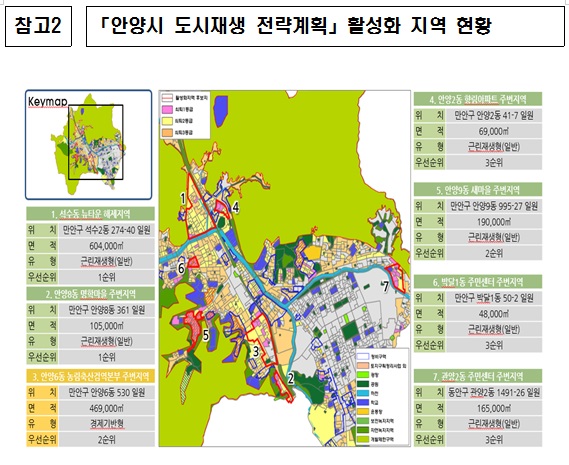
Gyeonggi Province recently conducted an examination of the urban regeneration strategic plans submitted by Seongnam and Anyang cities and granted final approval on the 26th.
As a result, the number of target areas for urban regeneration projects in Gyeonggi Province expanded from the existing 5 in Bucheon and 7 in Pyeongtaek to a total of 36, combining 17 in Seongnam and 7 in Anyang.
The 'Urban Regeneration Strategic Plan' is an urban planning initiative aimed at revitalizing aging downtown areas experiencing difficulties due to narrow roads and old buildings. It is established by each city and county and approved by Gyeonggi Province according to the 'Special Act on Urban Regeneration Activation and Support' implemented in December 2013.
Each city and county diagnoses the degree of urban decline through indicators such as population and industrial facility decline, and aging buildings, comprehensively considering the urgency and ripple effects of urban regeneration to select urban regeneration activation areas and establish regeneration strategies.
Urban regeneration activation areas are classified by purpose into 'Economic Base Type' pursued for economic function regeneration in industrial complexes, railroads, and industrial zones, and 'Neighborhood Type' pursued for improvement of residential living environments.
According to the Ministry of Land, Infrastructure and Transport diagnosis, 35 out of 48 administrative districts in Seongnam City, representing 73 percent, were identified as declining areas. The city designated a total of 17 areas as urban regeneration activation areas, including ▲9 regions such as Taepyeong-dong in Sujung-gu ▲4 regions such as Sangdaewon in Jungwon-gu ▲4 regions such as Yatap 3-dong in Bundang-gu. By type, they consist of 11 general neighborhood type, 4 downtown center type, and 2 economic base type.

Seongnam City plans to pursue Taepyeong 2·4, Taepyeong 4-2, Sujin 2, Dandae-nonggol, and Gwangwang 2-1 areas as Phase 1 projects. These areas, characterized by concentrated old and deteriorated buildings and inadequate basic living infrastructure such as roads, will implement district-level residential environment improvements, expansion of basic living infrastructure, and revitalization of resident community.
Furthermore, Anyang City's diagnosis revealed that 21 out of 31 administrative districts, accounting for 68 percent, are declining areas. The city designated 7 areas as urban regeneration activation areas: ▲Seoksu ▲Anyang 2-dong ▲Anyang 6-dong ▲Anyang 8-dong ▲Anyang 9-dong ▲Bakdal 1-dong ▲Gwanyang 2-dong. By type, they consist of 6 general neighborhood type and 1 economic base type.
Anyang City plans to pursue Seoksu 2-dong and Anyang 8-dong areas as Phase 1 projects. Seoksu 2-dong, a former New Town redevelopment area, will pursue small-scale maintenance to improve deteriorated buildings and implement urban regeneration strategies utilizing the nearby military base relocation site and Man'an Bridge, a provincial designated cultural property. Anyang 8-dong has established regeneration strategies that will install parks, parking lots, and joint waste disposal facilities while fostering children's support programs.
A Gyeonggi Province official stated, "With Seongnam and Anyang cities receiving approval of their urban regeneration strategic plans, the entire province's urban regeneration new deal projects have gained full momentum," adding, "In order to promptly pursue urban regeneration new deal projects, we plan to provide consulting to 7 cities and counties currently conducting strategic plan establishment projects in addition to the existing 4 cities."
Gyeonggi Province is currently reviewing urban regeneration strategic plans submitted by Pocheon and Uiwang cities, and explained that five cities and counties—Suwon, Goyang, Yongin, Gunpo, and Gwangju—are preparing to submit applications for urban regeneration strategic plan approval.


Loading comments…