


Gyeonggi Province Approves Hwaseong's 2035 Basic Urban Development Plan
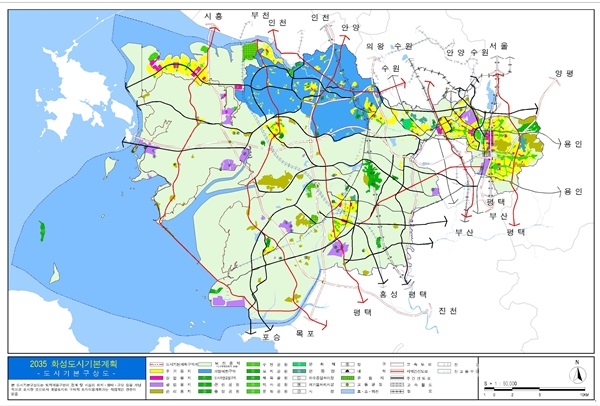
[Suwon Ilbo=Reporter Hong Sung-gil] Gyeonggi Province announced on the 24th that it approved the '2035 Hwaseong Basic Urban Development Plan (Draft)' submitted by Hwaseong City on the 21st.
The '2035 Hwaseong Basic Urban Development Plan' is a statutory top-tier plan that presents Hwaseong City's future vision and long-term urban development strategies, serving as an urban development roadmap that provides basic direction not only for spatial planning but also for all plans and policy formulation.
Examining the Hwaseong urban development plan, the city's target planned population for 2035 was set at 1.196 million, taking into account population inflows from various development projects and other factors. As of the end of April this year, Hwaseong City's registered population stands at 821,000.
Of Hwaseong City's total area of 1,126.13 sq. km, 36.469 sq. km of developable land in preparation for urban growth was designated as planned urbanization land, the existing developed areas with formed urbanization of 98.824 sq. km was designated as urbanized land, and the remaining 990.837 sq. km was designated as conservation land, finalizing the land-use plan.
Considering changes in urban conditions, the city's spatial structure and living zones were reorganized. Hwaseong City established its urban spatial structure with six city centers—Dongtan, Byeongjeom, Hyangnam, Bongdam, Namyang, and Songsan—and nine regions including Jeongnam, Yanggam, Paltan, Jangan, Ujeong, Maesong, Bibong, Mado, and Seoshin, reorganizing living zones into two areas: east and west.
Accordingly, the eastern living zone including Dongtan and Byeongjeom is planned to be developed as a 'Smart Residential Environment City' with transportation, culture, and cutting-edge industry functions, while the western living zone including Hyangnam, Bongdam, Namyang, and Songsan is planned to be developed as an 'Eco-Ecological Self-Sufficient City' with education, administration, and tourism as core functions.
Key transportation plans reflect the transportation network system including the Sinbundang Line extension (Homaesil~Bongdam) under the Third National Railroad Construction Plan, the Dongtan Line 1 (Mangpo Station~Osan Station) and Dongtan Line 2 (Byeongjeom Station~Dongtan New City 2) under the Gyeonggi Province Urban Railroad Network Construction Plan, and the Second Outer Ring Expressway.
Gyeonggi Province evaluated that the approval of the 2035 Hwaseong Basic Urban Development Plan has established a foundation for Hwaseong City to pursue balanced development between the east and west regions and created an opportunity for growth as a future economic city, an enjoyable tourism city, and an education and welfare city.
The approved 2035 Hwaseong Basic Urban Development Plan is scheduled to be released to the public through Hwaseong City's website in June.


Loading comments…