


Gyeonggi Province Announces 2 Trillion Won 'Economic Quarantine Measures' in Response to COVID-19 Emergency
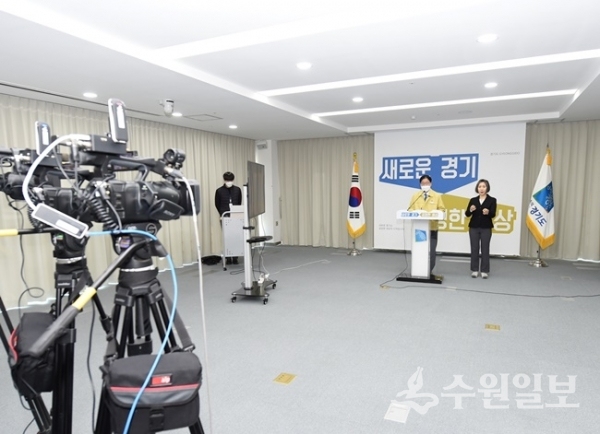
[Suwon Ilbo=Park No-hun Reporter] Gyeonggi Province is mobilizing a total of 2.4518 trillion won to overcome the emergency economic situation caused by the spread of COVID-19, implementing diverse economic measures including expansion of special management funds, employment stability, and activation of small businesses and SMEs as emergency response measures.
Kim Gyu-sik, Economic Planning Director of Gyeonggi Province, held a press conference at the North Building of Gyeonggi Provincial Government Office on the 9th to announce 'Emergency Economic Measures to Minimize COVID-19 Damage.'
These measures are part of an 'economic quarantine' initiative aimed at minimizing the shock and damage to the livelihood economy by pursuing swift and accurate Gyeonggi Province-level measures in response to the contraction of all economic and consumer activities and increased emotional fatigue due to COVID-19.
Accordingly, the province plans to invest a total of 2.4518 trillion won across 6 sectors: 'Timely Financial Support 1.85 trillion won', 'Employment Stability 59 billion won', 'Small Business Support 536.8 billion won', 'SME Export Support 4.8 billion won', 'Untact Platform Construction 1.2 billion won', and 'Economic Support System Operations' to implement comprehensive economic response measures.
First, to enable small businesses and SMEs to overcome the economic crisis caused by COVID-19, the province plans to expand 'COVID-19 Special Management Funds' from the existing 200 billion won to an additional 920 billion won, providing a total of 1.12 trillion won in loans. Of this, SME support will be 520 billion won and small business support will be 400 billion won, with a separate reserve of 200 billion won allocated to actively respond to rapidly changing circumstances.
Additionally, the province will expand the scale of guarantee issuance through Gyeonggi Credit Guarantee Foundation from the existing 3.1 trillion won to 4 trillion won—an increase of 920 billion won—to address liquidity crises for small businesses and SMEs. The guarantee issuance processing period, which previously took an average of 27 days, has been streamlined to be processed within 14 days.
Second, the province will pursue livelihood economy recovery through immediate emergency employment measures. First, various workforce development projects suspended due to COVID-19 will be converted to online formats, and full training allowances will be provided to participating trainees. For instructors facing livelihood difficulties due to educational training suspensions, 30% of training fees will be paid in advance.
Additionally, the province has secured 15 billion won in national funding to implement a 'Regional Employment Response Special Support Project' that provides up to 500,000 won per month for 2 months to workers experiencing unemployment leave without pay, special employment workers, freelancers, and other workers in employment blind spots facing crisis due to COVID-19. Simultaneously, the province plans to prepare expansion of public jobs for unemployed residents and job fairs to be implemented immediately when the spread of infectious disease subsides.
Third, to revitalize depressed local economies including traditional markets and small businesses, the province is proceeding with 'Disaster Basic Income' payments through local currency and credit cards. It plans to raise this year's local currency issuance target from the existing 800 billion won to 1.2567 trillion won, and increase the discount rate to 10% for 4 months from March to July to promote consumption within the region. Promotional activities to activate local currency will also be pursued.
To guarantee the survival rights of small businesses, the province will strengthen competitiveness through business environment improvement and market development projects, and support closure, business conversion, and re-startup for those dreaming of a comeback. To expand the social safety net for self-employed workers, the province will support employment insurance premiums and yellow umbrella mutual aid subscriptions, and implement special fund support of 26 billion won for small business owners with extremely low credit ratings of grade 7 or below.
Additionally, the province plans to invest 25 billion won in traditional market and shopping area activation including promotion marketing and shared delivery system construction, Commercial Revitalization Zones, and Gyeonggi Innovation Markets, while implementing various projects including merchant community formation, regional collaboration projects, online marketing, and specialized development using cultural and tourism resources to strengthen the self-sustaining power of alleyway commercial areas.
Fourth, as export-related damage cases such as contract cancellations and uncollected export payments are increasing due to the global spread of infectious disease, the province will implement export insurance fee support projects targeting 3,000 SMEs and conduct returning business support projects for stable domestic returns for companies facing difficulties in overseas operations. For companies facing difficulties in face-to-face contact with overseas buyers such as cancellation of overseas exhibitions and international business trips, online overseas marketing and non-face-to-face video consultation services will be supported.
Furthermore, the province will support domestic and international market development for 'antibacterial masks' produced through self-collaboration by COVID-19 affected textile companies, and will reduce lease fees by 50% at the Gyeonggi Venture Startup Support Center to address management difficulties of venture and startup companies. Additionally, the province will invest 1 billion won in clinical trial support projects to aid active research activities of companies related to COVID-19 treatment development.
Fifth, as 'internet and non-face-to-face online economy' has emerged as an important issue recently, the province will invest 1.25 billion won in building related infrastructure. First, with 520 million won, the province will establish a 'Construction Job Recruitment and Job Seeking Platform' enabling non-face-to-face hiring, and plans to invest 730 million won in activating the online economy in alleyway commercial areas, including 'Small Business E-Commerce Platform Construction' linked with local currency payment services.
Sixth, the province will continue to operate various economic sector support systems including 'COVID-19 Response Economic Task Force', 'Small Business and SME Countermeasures Headquarters', 'Export Difficulty Integrated Support Center', and 'Industrial Complex Support Cooperation System' to discover and implement effective customized measures, and will promptly provide infectious disease-related data to help private and public sectors and companies respond promptly.
Economic Planning Director Kim Gyu-sik stated, "With the recognition that infectious disease issues are directly linked to economic issues, we will continuously monitor the ever-changing economic situation, identify problems, and discover pinpoint policies suited to circumstances. We will focus on recovering the livelihood economy through proactive, swift, and accurate response measures to become a source of strength for residents suffering from COVID-19 to endure difficulties."

Loading comments…