


Yeouido Column Those Who Defamed Ahn Jung-geun
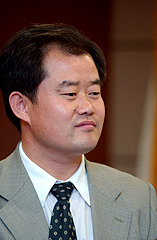 | ||
| ▲ Yeouido News Service, Jung Ji-hwan, Senior Correspondent | ||
"Ahn Jung-geun is etched so deeply and painfully in the minds of young students. Picture postcards and photocopies bearing Ahn Jung-geun's photograph were found in virtually every house whenever domestic searches were conducted for seditious elements."(From an article in the Dong-A Ilbo during Japanese colonial rule) "In school dormitories, the topic of conversation was always how Ahn Jung-geun would have appeared at Harbin Station carrying out the assassination of Ito Hirobumi, who would arrive by train with numerous attendants."(From <Arirang> by Nora Wales)
These are testimonies showing that Dr. Ahn Jung-geun had become the ultimate superstar among intellectuals seeking independence during the Japanese colonial period. This social phenomenon, which could be termed an "Ahn Jung-geun syndrome," was not confined to the Japanese colonial era. At the 36th anniversary memorial service held on March 26, 1946 at Seoul Stadium, the year after liberation, a massive crowd of 100,000 people gathered. Considering that the population of South Korea at that time barely exceeded 10 million, this was indeed a significant number.
However, since the establishment of the divided government, Dr. Ahn Jung-geun has not received proper historical treatment in South Korea. Instances of "desecrating" rather than "venerating" Dr. Ahn have been witnessed countless times, with the most easily cited example being the statue. Upon visiting the Ahn Jung-geun Memorial Hall on Namsan, the first thing one encounters is a statue of Ahn described as a "young man standing with the Taegeuk flag." Yet the sculptor who created this statue, Kim Gyeong-seung, was a representative sculptor with a pro-Japanese collaboration record.
There is something that cannot be overlooked regarding the historical defamation of Dr. Ahn Jung-geun. It is the inherent limitation of the "Ahn Jung-geun Memorial Society" (hereafter, the Society), the only legitimate organization dedicated to preserving Dr. Ahn's legacy. In fact, examining the faces of successive chairmen and key officials reveals an unavoidable question: does the Society truly align with Dr. Ahn's spirit of independence? This is because the majority of them either have pro-Japanese collaboration records or enjoyed high positions and comfortable lives under dictatorial regimes.
Particularly striking is the contrast between the lives of Yun Chi-young, who served as both the first and third chairmen of the Society, and that of Dr. Ahn Jung-geun. In other words, while Dr. Ahn typified an "independence fighter," Yun Chi-young can be said to epitomize a "pro-Japanese collaborator." The Institute for Research on Collaborationist Activities defines Yun Chi-young as a representative example of those who "fawned over foreign powers and authoritarian regimes and lived well," and for good reason. Furthermore, the families to which these two men belonged subsequently demonstrated in stark reality the shameful maxim that "if one resists Japan, three generations perish, but if one collaborates with Japan, three generations prosper."
On the 60th anniversary of liberation. We must face painfully the heavy responsibility we bear to end the historical defamation of Dr. Ahn Jung-geun.
Jung Ji-hwan (Senior Correspondent, Yeouido News Service)
Loading comments…