


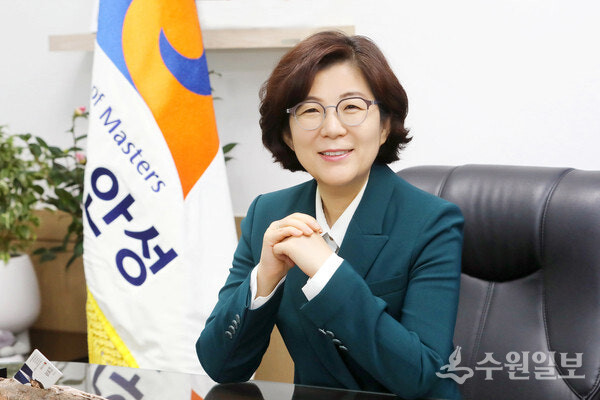
Dear citizens of Anseong, and esteemed public officials!
The new year of 2026, the Year of the Red Horse (丙午年), has dawned.
The year of the red horse symbolizes not hesitation but progress, not preparation but execution.
I hope that all the plans you have prepared will bear clear fruit this year.
Last year, amid strong uncertainties at home and abroad, we did not stop the momentum of change and innovation for Anseong's development.
A year ago at this place, I spoke of the risk of regional decline and promised to make 2025 the first year of sustainable Anseong, and that promise is now showing in numbers and achievements.
Over the past year, Anseong's population increased by 3,430, surpassing 210,000.
The beam-raising ceremony for a 1.2 trillion-won future mobility battery research institute, the full-scale promotion of the Dongsin Industrial Complex, and investment achievements of approximately 500 billion won through investment attraction briefing sessions were symbolic moments of Anseong's leap beyond an agricultural and logistics city to become a hub of advanced manufacturing and technology industries.
Change does not end in numbers but reaches our lives directly through jobs, our income, and the choice to continue living in Anseong.
This change is no accident.
It is a result we created together—you who extended your hand first during difficult times and stayed with us to the end with the belief that we could succeed.
On this occasion, I express my heartfelt gratitude for all your efforts and companionship.
Dear citizens who love Anseong,
Our reality as we face 2026 is by no means easy.
With prolonged economic slowdown in Gyeonggi Province, rapid aging, and shifting international circumstances, the environment surrounding our city is becoming increasingly complex and uncertain.
However, we will not stop because of difficulties.
We will not waste time making excuses.
This year is a critical period when we must rise to a higher level beyond past achievements.
If we miss this opportunity, nature will be damaged by reckless overdevelopment, and we risk becoming one of many provincial cities facing extinction.
Conversely, now is the time to achieve both structural transformation and qualitative growth simultaneously, making 'sustainable Anseong' a reality.
The four-character phrase that will define Anseong City in 2026 is 'seungse doyak' (乘勢跳躍—riding the momentum with a great leap).
It means boldly riding the accumulated flow of achievements and executing transformation that changes the city's very nature without hesitation.
Internally, industrial restructuring and changes in population and welfare needs are accelerating; externally, energy transition, supply chain reconfiguration, and digital transformation are shaping competitiveness.
Within this environment, Anseong City must respond with 'seungse doyak'.
I will clarify the key tasks for 2026 into three pillars.
First, fostering strategic industries and revitalizing the people's economy.
Centered on the Industrial Promotion Agency, which will open its doors in the first half of this year, we will foster semiconductors, parts and materials, food, and manufacturing as core industries.
We will integrate research and development (R&D;), technology support, talent development, and market development to build an integrated industrial ecosystem where industry, academia, and research move together.
So that businesses do not spend time finding their way, administration will become the path.
We will expand company-customized youth talent programs and build an integrated control tower for business support, including strengthened collaboration between local universities, businesses, and research institutions, and the adoption of innovative technologies.
We will improve working conditions and enhance corporate competitiveness through industrial complex modernization and youth culture center development.
We will create a foundation where young people grown in Anseong can grow with the region and achieve their dreams locally.
We will develop traditional markets and alleyway commercial areas into culture-tourism-oriented commercial zones linked to cultural city projects and urban regeneration initiatives.
Through small business management support and local currency activation, we will create a virtuous cycle of the local economy that citizens can feel.
Second, rapid renewable energy transition to strengthen urban competitiveness.
Renewable energy transition is no longer merely an environmental policy but has become a core factor determining urban survival and competitiveness.
Anseong's current electricity self-sufficiency rate is 6.4%.
Prolonged economic slowdown, continuous rises in electricity costs, and increasing energy demand in industrial complexes are realities we face now.
A structure dependent on external power sources makes it difficult to guarantee industrial growth or stable city operations.
In particular, the implementation of the Distributed Energy Special Act and the introduction of region-specific differential electricity rate systems pose a crisis: cities with low energy self-sufficiency could immediately face weakened industrial competitiveness.
Energy transition is not a choice between doing it or not—it is an essential strategy to protect our livelihoods.
If we do not respond proactively to this change, our city's sustainability will be shaken.
Therefore, Anseong City will establish RE100-based distributed energy specialized industrial complexes and expand solar installations on public land.
Farmland is becoming an energy resource in this age.
We will expand agrivoltaics and energy-independent villages to create a structure where agriculture and energy coexist.
To achieve this, we will build an Anseong-style energy platform with citizens, businesses, and administration participating together.
Through a structure where electricity produced locally is used locally, we will ensure that energy transition benefits are clearly felt as cost reductions for businesses, reduced daily costs for citizens, and tangible profits.
We will realize Anseong as a city taking responsibility for its own energy, a city where energy becomes competitive advantage, and a stable green growth city.
Third, we will enhance the city's appeal by cultivating 'Anseong's identity,' expanding the residential population through sustainable tourism and culture.
'Anseong's identity' is our clear competitive advantage created together by nature, history, and people.
In the 2025 Anseong City social survey, 38.8% of citizens cited pleasant natural environment, diverse leisure facilities, and traditional cultural heritage as Anseong's core competitiveness.
We will clearly connect these values to cultural development, tourism, and local economic revitalization.
Through cultural city projects, downtown regeneration projects, and cultural center remodeling, we will expand cultural spaces in daily life and robustly support the creative activities of local artists, young artists, and craftspeople.
We will create a city where 'culture' is not an event for special occasions but where 'everyday life' itself is culture.
Tourism will not end with 'visiting'.
Together with lake development projects, we will expand residency-type tourism content incorporating history and human stories, adding reasons to stay longer.
Especially in preparation for the 2027 World Youth Conference, we will systematically improve the Miryae Sanctuary and prepare related content, making Anseong a tourism destination visited by people worldwide.
By fully implementing the residential population platform Anseong Onsimon system, we will establish a structure where tourism leads to consumption and participation in the region, encouraging repeat visits.
Already, through the region's distinctive cafes, camping sites, fishing spots, golf courses, sky observation decks, Bauduk Festival, and cultural city projects, steady streams of visitors discovering and coming to experience Anseong's charms continue to grow.
Now we will transform visitors into residential population—those who stay, consume, and participate, becoming members of the Anseong community.
We will create a structure where people stay longer in Anseong, purchase Anseong goods, and contribute through the Hometown Love donation program, ensuring those profits clearly return to citizens' lives.
Economic innovation through strategic industry fostering and livelihood economy revitalization, renewable energy transition based on local production and consumption, and expansion of residential population through sustainable tourism and culture—these three pillars will be the core axes opening Anseong's sustainable future.
These are implementation-centered choices to create clear change in our lives, not abstract slogans.
Beyond this, in every field—from agriculture and livestock to welfare, education, roads, and environment—we will steadily continue what we have been doing, unhesitatingly pursue necessary changes, and ensure results.
To carry out the aforementioned tasks well, in 2026 we must accomplish two particular things.
First, we must read the world's changes and change how we work.
The standards and frameworks of the past can no longer address the problems we face today.
The boundaries of everything in our society are rapidly breaking down.
Age and gender are no longer criteria that define roles.
There are healthy elderly, and middle-aged people taking on new challenges.
The past approach of distinguishing 'who needs protection' only by age now contradicts reality.
Working, caring, and taking responsibility are not divided by gender.
Foreigners and multicultural communities are not a name for minorities we occasionally encounter.
They are already neighbors supporting Anseong together.
They are colleagues with whom we must build the future.
New lifestyles such as 'one-point-five households'—transcending categories like single-person households or young-person households and desiring both autonomy and connection—are already becoming policy premises.
South Korea is no longer a country with four distinct seasons.
We now experience weather phenomena in our daily lives that seemed to occur once every hundred years.
Climate has now become a condition that must be first considered when designing all policies and projects.
We must heighten climate sensitivity in planning policies and implementing projects.
Large boundaries between industries are dissolving, and boundaries between sectors are rapidly disappearing.
In response, businesses are boldly crossing boundaries and seeking new breakthroughs through collaboration rather than holding fast to their domains.
Successful companies are those that take sharing instead of monopoly and cooperation instead of competition as their growth engines.
Administration must also change to succeed.
We must transition from 'management' to 'solidarity' approaches.
Administration should not divide and separate but should collaborate in design and implementation.
As boundaries between diverse lifestyles and sectors dissolve, we must lower boundaries between departments, between policies, and between administration and citizens, working in structures of shared responsibility.
Second, we must create a structure where resources produced locally are consumed and circulated within the region, returning to our neighbors' jobs and lives.
Local economic revitalization must be verified not in simple statistics but in improved quality of life for individual citizens.
What we aim to achieve in local economic revitalization is to minimize resources flowing out of Anseong and to maintain continuous circulation of production-consumption-reinvestment-recycling within Anseong.
Through participation of businesses and residents in Anseong, we will create jobs and consume goods and services produced in Anseong within the region, generating growth momentum from the region itself.
I request that administration take the lead in local economic revitalization.
I ask that you noticeably increase the share of local expenditure in all projects executed by budget.
This is not a choice but an administrative responsibility.
It is natural to feel fear and loneliness before change.
Letting go of familiar ways can feel uncomfortable.
There will certainly be moments of worry: 'What if citizens don't understand?'
But when we calmly explain why we seek change and why we wish to move forward together, moving beyond that worry, fear diminishes.
When administration first clarifies its purpose, hides nothing about the process, and extends its hand saying 'let's go together,' citizens emerge not as policy subjects but as agents of change.
The power to solve problems lies with citizens.
Administration must play not the role of deciding first but must fully perform roles of coordinating, connecting, and providing responsible support.
When people and people, businesses and regions, and administration and citizens connect toward the same purpose, Anseong can move toward a sustainable future.
Citizens of Anseong and public officials building a better life together,
The Year of the Red Horse demonstrates its greatest power when we move together.
The horse runs fast, but its direction and strength are created not alone but within the herd.
Let us move quickly, but let us always move together.
Building on the experience and strength we have accumulated, let us trust and help each other and create an even greater leap for Anseong.
Wishing you abundant blessings in the new year and eternal health.
Loading comments…