


Special Report Suwon City Transformed 6} 'Suwon Carbon-Neutral Green City Project'

[Suwon Ilbo=Reporter Jung Jun-seong] Suwon Special Metropolitan City, an environmental capital, is swiftly responding to climate change and creating a sustainable future for the city, with the 'Suwon Carbon-Neutral Green City Project' being promoted around Goesaek-dong in Seonjae-gu serving as the vehicle. The city is pursuing the green city project with the goal of making the city safer, more pleasant, and more competitive, going beyond simply reducing carbon emissions.
■ 'Carbon-Neutral Green City Project' spanning six years until next year

The Suwon Carbon-Neutral Green City Project, which began after being selected for the Ministry of Environment's public recruitment project in 2022, is a long-term project spanning six years until next year. A total of 50 billion won will be invested, comprising 40 billion won in project costs including national and provincial support and 10 billion won in linked projects by Suwon City. The target area covers approximately 9 km² of West Suwon, including Goesaek-dong in Gwonseon-gu as the center, with parts of Tapdong, Homaesil-dong, Omokcheon-dong, Pyeong-dong, and Pyeongni-dong. The goal is to reduce greenhouse gas emissions by 40% from what was emitted in 2018 in the relevant area by 2030. This will reduce greenhouse gas emissions by approximately 110,000 tons of CO₂ equivalent, which is equivalent to planting approximately 10 million trees.
The city first focused on establishing a carbon-neutral foundation. The project was planned across five key sectors: energy paradigm transition, expansion of carbon absorption sources, promotion of resource recycling, climate change adaptation, and social awareness transformation. Among these, the city prioritized the installation of infrastructure to minimize damage to citizens vulnerable to climate change. Nine smart bus shelters, including those at Goesaek Station and Omokcheon Station, and climate shelters such as rest areas in Jungbodeul Park that protect citizens from weather and climate change have been created. A facility to block entry during weather disasters has been installed at the Goesaek Underground Road. Additionally, 540 street lights on Seoburo have been replaced with LEDs for energy transition, and school forests have been created around Yeongsin Middle School and Yeongsin Girls' High School to increase carbon absorption sources.
The foundation-building for Suwon's green city is expected to become clear in outline this year. This is because energy management systems will be installed in 16 public buildings and 11 renewable energy generation facilities using solar power will be set up to begin the full transition of the energy paradigm. Additionally, infrastructure for eco-friendly transportation including bicycle roads and PM stations will be improved. Smart resource centers at 11 locations and rainwater recycling facilities and rain gardens will increase by 10 locations to aid resource circulation. Shade structures with solar panels and permeable blocks to reduce urban heat island effects are also planned to be added by next year.
■ Transition to a carbon-neutral society led by citizens

The core of the Suwon-style green city project is to establish carbon neutrality as a common lifestyle in the local community based on infrastructure development. This represents an effort to achieve a transition to a carbon-neutral society led by citizens. To this end, the city has supported various social transition projects and sown seeds of carbon neutrality that citizens can practice.
A representative example is the implementation of living lab projects centered on residents and businesses. A process unfolded where each stakeholder actively worked on customized tasks to solve carbon-neutral problems they face. Communities reduced carbon emissions by recycling banners and promoting eco-friendly farming methods. They also circulated ice packs as resources, created upcycled flower pots in alleyways, and developed and provided education on vegetarian cooking methods. A total of 12 communities with 1,993 participants took part in the living lab. Additionally, technology-focused living labs operated in connection with five companies to verify low-rise residential carbon-neutral technology and carbon emission monitoring.
The resident action group, which spreads carbon-neutral commitment, has also been actively engaged. The 65 members held 49 meetings and participated in conferences, education, workshops, practical activities, and the development of village plans. In particular, the resident action group established a mid-to-long-term carbon-neutral village plan based on a survey of local resources. With the slogan 'Earth, stay the same! I will change!' they presented a direction for citizen action toward carbon neutrality.
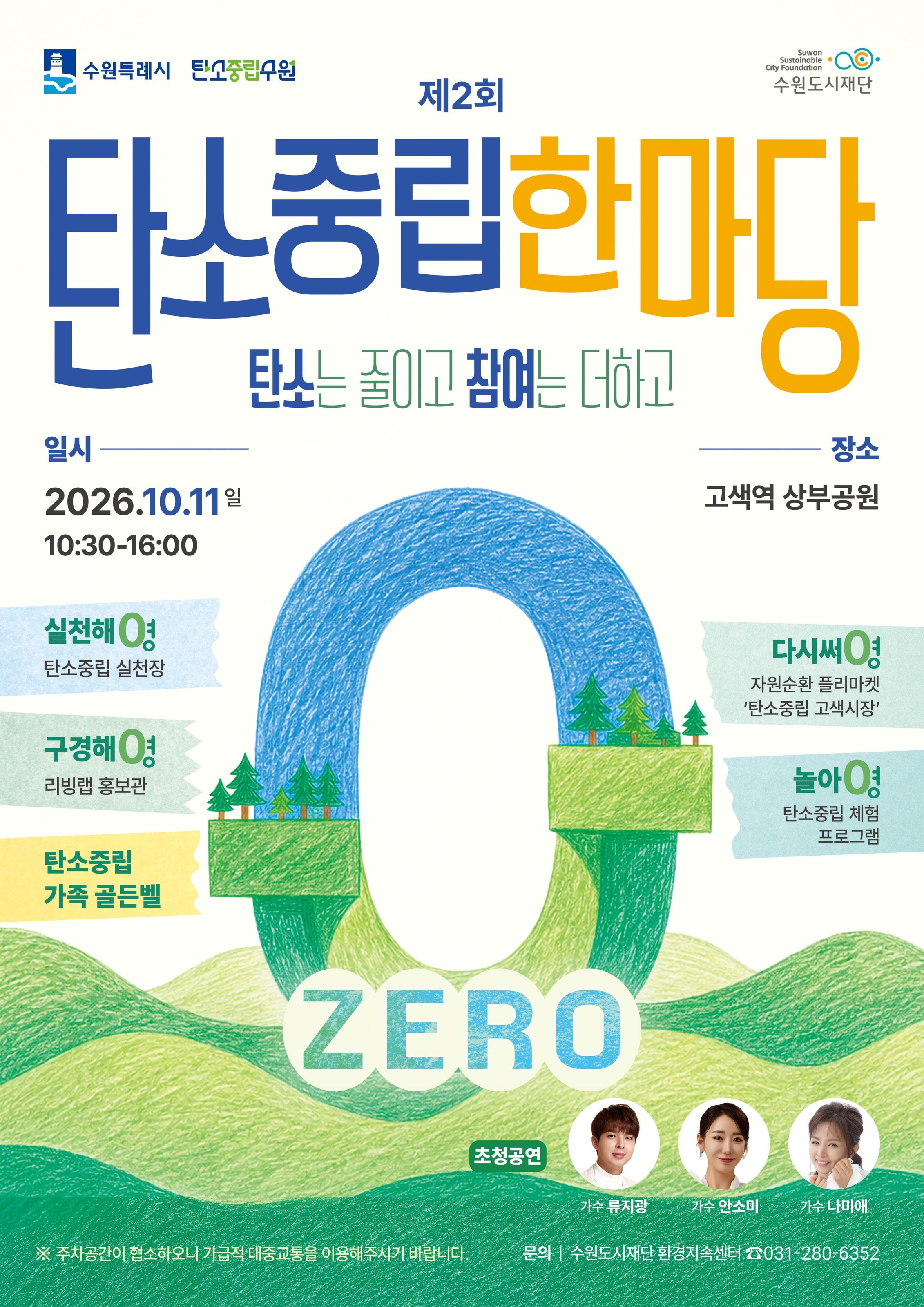
The city will also conduct various practical culture programs for the carbon-neutral green city in diverse sectors this year to expand citizen participation commitment. Plans include living labs, education, visits to advanced cases, and events to experience carbon-neutral culture.
■ Carbon-neutral realization model 'Goesaek-dong'

What draws the most expectations in Suwon's green city project is Goesaek Station. With major projects concentrated around Goesaek Station, it promises a transformation into an energy-efficient village. The plan is to make parts of Goesaek-dong, where old residential areas are densely packed, the core of carbon neutrality.
Goesaek-dong includes old residential areas, administrative agencies in West Suwon, and industries located in Deltaplex, making it an ideal location to recreate the characteristics of a city as they are. In fact, from 2018 to 2023, the proportion of greenhouse gas emissions by sector in the target area was similar to that of Suwon City as a whole. It is an excellent site for creating an urban carbon-neutral model. Based on this, the city concentrated on creating a structure where carbon neutrality can be systematized and practiced in Goesaek-dong.
The 'Carbon-Neutral Village, Goesaek' project will invest 15 billion won from the green city project budget and 10 billion won in linked projects by Suwon City to pursue a total of 34 projects. First, the upper space of Goesaek Station will be developed into a 'Green Plaza' functioning as an urban ecological forest where everyone communicates. It will transform into a specialized space that concentrates a resource recycling center, courtyard, solar shade structures, and rainwater pergola. The main road leading from Goesaek Station to Deltaplex will create a 'Green Road' where everyone feels safe. Solar street lights, permeable blocks, and rest areas will be created. Finally, the surrounding low-rise residential areas will be focused on remodeling and alley environment improvement support to create a regenerated village 'Green Alley' where everyone can breathe together. The plan is to create changes in residents' daily spaces so that carbon neutrality can be felt up close.
A city official stated, "We will faithfully pursue projects so that the carbon-neutral realization model born in the Goesaek-dong area can become an alternative in the age of climate crisis," and added, "We will create a Suwon where carbon neutrality becomes reality and climate crisis response leads to city competitiveness."
Loading comments…