


Suwon, We Will Make Into a City of 'Rosy Future'
Suwon, the nation's largest basic local government with a population of 1.1 million, is now focused on becoming a metropolitan-level city. In 2009, marking the 60th anniversary of its elevation to city status on August 15, 1949, it is the starting point of change. Metropolitanization is already underway through high-tech industrialization centered on Samsung Electronics and the Suwon Industrial Complex, eco-friendly residential spaces, high-value-added infrastructure construction, and the introduction of Suwon Light Rail Transit, a future public transportation system. The shoulders of Suwon's Development Bureau, which carries out these projects, are inevitably heavy. We met with the working-level officials of the Development Bureau, who are building Suwon's future, to hear about its rosy future.
<Editor's Note>
●Kim Ji-wan, Director of Development Bureau: "Focusing on Changing the Industrial Structure of Suwon"
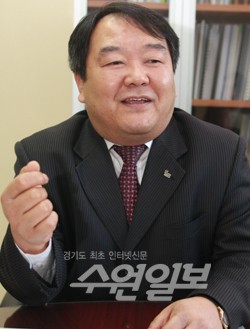
First, following the creation of Suwon Industrial Complexes 1 and 2 for revitalizing the local economy and creating jobs, we will ensure the compensation for industrial sites proceeds smoothly so that Complex 3 can break ground in September. Additionally, we are accelerating the construction of convention centers to create high value-added products through 21st-century pollution-free future industries through expanded international cultural exchanges and a shift to an advanced industrial structure. The Gwanggyo new town development zone, where the convention center will be located, will be developed as an administrative complex city and self-sufficient new city by resolving housing shortages in the Seoul Metropolitan Area and providing sites for cutting-edge industries.
In addition, we are promoting balanced urban development of Suwon through development of the relatively underdeveloped West Suwon area, and are proceeding with the Homaesil new town development project for homeless low-income residents with a completion target of 2012. The Gojjipmal urban development project as a residential facility behind the industrial complex and the Kwonseon and Sindong district urban development projects, incorporating natural topography and design motifs, are expected to be completed by 2012.
To resolve Suwon's traffic problems and improve the quality of public transportation services, we will hold public hearings on the basic plan for urban rail transit and resident briefings on preliminary environmental assessments for the introduction of light rail transit, an eco-friendly and safe new transportation system, and complete the basic plan work.
●Han Sang-yul, Section Chief of Public Development: "Accelerating Construction of Suwon Convention Center for Pollution-Free High Value-Added Industries"
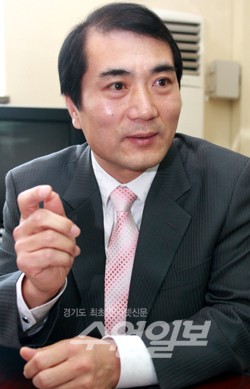
First, the creation of Industrial Complex 1 generated 4,000 jobs, and Complex 2 completed its complex development project at the end of last year and is currently seeing new factory construction, with more workers expected to work there by next year. For Complex 3, compensation for sites currently included in projects is underway, with groundbreaking planned for the second half of this year and project completion by 2012.
Additionally, through the construction of the Suwon Convention Center, we plan to foster local industries and serve as an incubator for companies. In particular, as a high-value-added future industry that can widely promote Suwon and the world cultural heritage site of "Hwaseong" to many countries around the world, we are promoting it through public calls based on private sector proposals.
According to reports by the Korean Culture and Tourism Research Institute and the Korea Local Government Management Evaluation Institute last year, the production ripple effect, value-added ripple effect, and local tax inflow effect generated by the operation of the Suwon Convention Center are estimated at 1.3 trillion won annually, and employment creation effect is estimated at approximately 7,400 people annually. Although there are difficult challenges due to issues with land supply methods, we are doing our best to ensure the project begins in the near future.
Urban development projects for three districts—Kwonseon, Sindong, and Gojjipmal—are being promoted to create pleasant residential complexes. The Kwonseon district had planned to sell apartments in early this year but is currently adjusting the sales schedule due to sluggish market conditions. The business operator will construct all buildings in the district, including shopping malls with multi-unit housing and detached houses, with specialized themes and beautiful designs for sale.
For the Sindong district, a site plan will be established to ensure balanced development of apartments and detached houses, and a waterside park will be created along the river so residents can conveniently use the Woncheon Stream walking trail, making it a well-being residential complex. We will establish development and land readjustment plans to accelerate the construction timeline. The Gojjipmal district, where urban infrastructure is weak, is being developed and promoted as a support complex behind Suwon Industrial Complex to prevent further deterioration and improve the urban environment.
●Ji Seong-ho, Section Chief of New City Projects: "Building an Enviable and Desirable City"
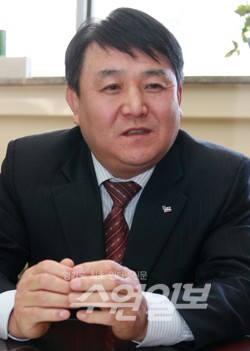
By 2011, the construction of a new city accommodating 77,500 residents (31,000 households) with coexisting leisure and culture will enhance the status of competitive international city Suwon and greatly contribute to the stability of national residential life and improvement of welfare through the formation of urban spatial structure and eco-friendly urban environment.
One of the most distinctive features of Gwanggyo New City is its highest green space ratio (41.7%) and lowest population density (68.7 people/hectare), which surpasses both Bundang and Ilsan as well as second-phase new cities such as Dongtan and Pangyo. Shindae Reservoir and Woncheon Reservoir are planned to be developed as vibrant lake parks reflecting the pleasant daily life of the city, and facilities including libraries, elderly and disability welfare facilities, social welfare facilities, a comprehensive cultural and arts center, and a local culture promotion center are scheduled for construction.
A water circulation management system will be installed, and a friendly water environment with retention ponds (artificial ponds) will be created throughout Gwanggyo New City to improve water quality in streams and reservoirs and serve as rest spaces for citizens. In particular, the development as a ubiquitous city (U-City) where advanced IT, the internet, and urban spaces harmonize and residents can receive public urban services such as weather, traffic, and disaster information through wired and wireless means is planned to become a standardization model.
The Homaesil new town development project is one of the government's housing policies for stabilizing housing for homeless low-income residents and low-income urban workers, constructing 19,240 households (55,796 people) around Homaesil-dong, with a completion target of 2012. Currently, the project is proceeding smoothly at 6.6% progress rate.
●Kim Bong-hee, Section Chief of Urban Rail Transit: "Introduction of 'Suwon Light Rail Transit,' Next-Generation Pollution-Free Public Transportation"
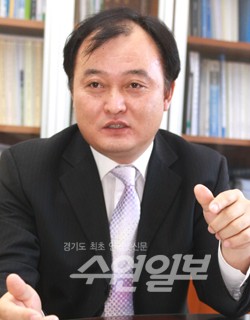
Although the city has many railroad lines compared to other provinces and cities, some are still under construction or in the planning stage, and public transportation usage rates are significantly low, particularly in the old city center areas such as Paldalmun. With large-scale new town developments planned in Yongin and Hwaseong, traffic volume is expected to increase in the future, so we plan to introduce light rail transit, a new public transportation system for the future.
This project began review through feasibility studies for urban rail construction by the Transportation Development Research Institute starting in 1995. In October 2006, a private investment facility business proposal for Suwon Light Rail Transit was received, and as a result of requesting a feasibility assessment by KDI, it was determined to have feasibility (B/C=1.2).
For approval of the basic urban rail plan, we have commissioned the development of the Suwon Urban Rail basic plan and are continuously promoting it by holding kick-off and interim briefing meetings. As a private sector project, an estimated total of 942.2 billion won is expected to be required (60% private investment, 10% cost-sharing, 18% national treasury, 12% local budget), with plans to complete by 2014 and begin operations in 2015.
Additionally, we are paying special attention to early opening of the ongoing metropolitan rail projects. For the Bundang Line, which is under construction, we are regularly inspecting traffic management systems and environmental maintenance around construction sites with supervision units and construction companies to minimize inconvenience to citizens caused by construction.
For the Su-Incheon Line, we are in close consultation with Korea Railroad Facility Corporation to resolve local residents' issues such as underground placement in Suwon sections and relocation of a rail yard. For the Shinbundang Line extension, we will continue to promote the project in connection with Gyeonggi Province and political circles to ensure the entire section undergoes simultaneous groundbreaking.
Discussion by Park Jang-hee / Compiled by Reporter Lee Jung-ha jungha98@
Video and Photography by Reporter Choo Sang-chul gag1112@
Previous format video attachments cannot be played at this time.


Loading comments…