


World-Renowned Paleontologists to Gather in Hwaseong
Suwon NewsUpdated 2013.11.12 14:03
Published 2013.11.12 13:55
Updated 2013.11.12 14:03
Hwaseong City to Host '2013 International Dinosaur Expedition Symposium' on December 4th
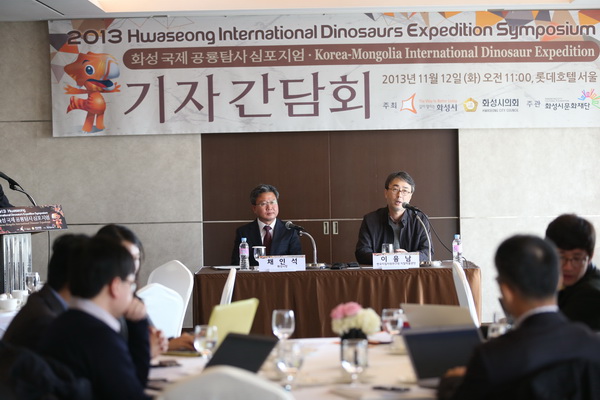
On the 12th, Hwaseong City held a press briefing for science correspondents at Seoul's Lotte Hotel to introduce the '2013 Hwaseong International Dinosaur Expedition Symposium' and explained the upcoming symposium scheduled for next month.
At the briefing, conducted through a presentation by Dr. Lee Yung-nam of the Korea Institute of Geoscience and Mineral Resources, key findings from the Korea-Mongolia dinosaur expedition project were unveiled in advance of the symposium, including a total of 694 specimens discovered over five years of exploration and major fossil discoveries.
Additionally, keynote speakers for the symposium were introduced, including Dr. Paul Norell, Director of the Center for Paleobiology at the American Museum of Natural History in New York, and Louis L. Jacobs of Southern Methodist University in the United States, former president of the International Society of Vertebrate Paleontology and co-researcher of the Korea-Mongolia project.
The '2013 Hwaseong International Dinosaur Expedition Symposium,' to be held for three days beginning December 4th, is expected to serve as a venue for sharing results of the Korea-Mongolia International Dinosaur Expedition (KID) Project, which was conducted in the Gobi Desert in Mongolia for five years from 2006 to 2010 under the direction of Dr. Lee Yung-nam.
The Korea-Mongolia International Dinosaur Expedition Project, conducted with support from Hwaseong City, involved 32 renowned paleontologists from a total of 10 countries: Korea, Mongolia, the United States, Canada, China, Japan, Argentina, Portugal, Sweden, and Australia.
Chae In-seok, Mayor of Hwaseong City, who attended the press briefing, said, "I am pleased that through the 2013 Hwaseong International Dinosaur Expedition Symposium, we can share our exploration results and re-examine the significance of Hwaseong City, where Korea's first ceratopsian dinosaur, Coreaceratops hwaseongensis, was discovered," and added, "As a leading local government in dinosaur exploration, we will make efforts to attract a natural history museum."
© Suwon Ilbo. Unauthorized reproduction and redistribution prohibited.



Loading comments…