


7 out of 10 Aging Housing Residents in Gyeonggi Province Say "I Will Repair My Home if Costs Are Supported"
[Suwon Ilbo=Park Nohoon Reporter] In response to the decline of the original downtown areas, national-level urban regeneration projects are being pursued.
Gyeonggi Province is carrying out 40 such projects, but improvements to residential environments that residents can feel are still insufficient.
Particularly, the deterioration of single-family and multi-family homes in the original downtown areas is serious, with approximately 231,000 buildings in Gyeonggi Province classified as aging and substandard buildings, yet improvement measures are lacking.
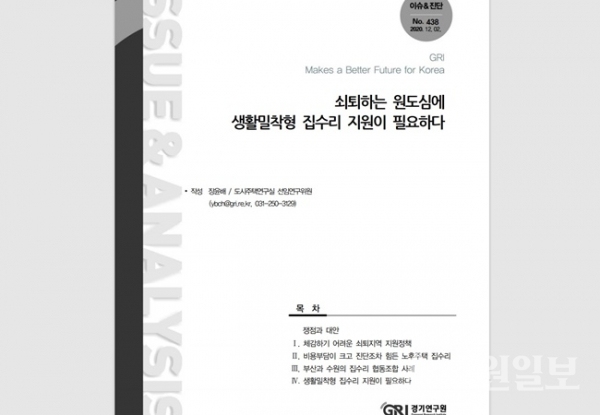
The Gyeonggi Research Institute, against this backdrop of original downtown area decline, has published "There is a Need for Daily Life-Focused Home Repair Support in Declining Original Downtown Areas," seeking home repair support measures.
About 40.9% of 565 eup-myeon-dong administrative districts in Gyeonggi Province, or 231 areas, are classified as declining regions, but only 40 urban regeneration projects have been implemented.
In Gyeonggi Province, approximately 231,000 single-family and multi-family homes are classified as aging and substandard buildings, concentrated in the original downtown areas.
Of these, aging single-family and multi-family homes located within urban redevelopment and urban regeneration project zones that can improve residential environments number only about 25,000 units, leaving roughly 200,000 units in urgent need of residential environment improvement measures such as home repairs.
The Gyeonggi Research Institute conducted face-to-face surveys from July to August among 200 households residing in single-family, multi-family, and multi-unit housing to gather opinions from Gyeonggi Province residents on home repair support.
According to the survey results, when considering home repairs, 38.5% of homeowner respondents cited "securing home repair costs" as a problem.
When asked about intention to participate in home repair support projects, 71.2% responded they would participate in "home repair cost support," while only 36.5% expressed intention to participate in "home repair loan brokerage and partial interest support."
The anticipated home repair costs homeowners estimated were most commonly "10 to 50 million won," followed by "5 to 10 million won."
The most inconvenient aspects of their residential areas were cited in order as parking shortage, aging buildings, absence of commercial facilities, and waste disposal problems.
When asked about the necessity of improving residential areas, 80.5% of respondents answered that "securing parking space" was highly necessary, and 79.0% answered that "storage space and system furniture" were highly necessary.
Finally, when asked about the role of a dedicated home repair organization, the responses regarding home repair contractor introduction and connection, information provision on home repair support projects, and housing condition diagnosis and consultation showed similar response rates.
Jang Yun-bae, senior research fellow at the Gyeonggi Research Institute, stated, "There is a need to advance Gyeonggi Province's home repair support policies aimed at residential environment improvements that residents can feel," and proposed that to differentiate Gyeonggi Province's home repair support from central government policies, pilot home repair projects should be pursued in urban redevelopment project release zones within the province.
New town release zones in Gyeonggi Province are located in 9 cities, and single-family and multi-family homes in these release zones that have been completed for more than 20 years account for approximately 17,000 units, representing 87.8% of the total, which served as the basis for this proposal.
The report sets households falling below the minimum housing standards as the first priority for home repair support targets, prioritizing support for the residential vulnerable classes, and also stipulates that in cases of tenants, support should be provided if the landlord agrees.
The basic local government proposes support targets, and Gyeonggi Province selects them under a basic-level and metropolitan-level cooperation system.
Jang, senior research fellow, added, "For declining original downtown areas, to enable residents to feel improvements in living environments and to promote integrated management and support through urban regeneration and home repairs, a home repair support center should be established at the Gyeonggi Urban Regeneration Support Center, and integrated home repair support functions should be strengthened."


Loading comments…