


Suwon Publishes Book Showcasing Achievements of Municipal Terms 5-7: 'People Welcome You. Brilliant Fragments of Suwon'

[Suwon Ilbo=Reporter Jung Jun-sung] Suwon City has published 'People Welcome You. Brilliant Fragments of Suwon', which documents municipal government achievements from the 5th to 7th elected terms, the city announced on the 20th.
▲Governance ▲Local autonomy and decentralization ▲Fairness ▲Culture and humanities ▲Youth and education ▲Nature and environment ▲Urban planning ▲Transportation ▲Safety ▲Local economy ▲Welfare ▲Innovation—the book covers achievements in 12 areas.
Over the past 11 years, externally the city has established itself as a 'metropolitan-level city', and internally, 'people-centered administration' has taken root. Since the launch of the 5th elected term, the city has consistently pursued 'cooperative governance' based on 'participation and communication'.
As time passed, cooperative governance strengthened further, permeating every aspect of municipal administration and becoming the foundation of all policies the city pursues today.
The 'Good Governance Committee', which monitors and evaluates progress on 'promises to citizens' and proposes and develops policy initiatives; the 'Urban Policy Citizen Planning Group', which provides input when formulating basic urban concepts; and the 'Residents Participatory Budgeting System', in which residents participate in budget allocations, are representative governance mechanisms.
The city also found solutions through governance to sharply conflicting issues. The 'Gwanggyo Mountain Coexistence Council', launched in July 2017 and active until February 2018, explored ways to alleviate inconveniences for residents around Gwanggyo Mountain while preserving its environment.
The Gwanggyo Mountain Coexistence Council, a private-public consultation body, held 25 meetings over eight months, collecting opinions from residents and citizens around Gwanggyo Mountain before achieving the signing of a 'Coexistence Cooperation Agreement for Sustainable Management of the Gwanggyo Mountain Area'.
Based on the agreement, the city submitted a 'Water System Master Plan (Revision) Plan' to the Ministry of Environment that included content on partial release of the Gwanggyo Water Source Protection Area, and the ministry approved the revision plan.
In July 2019, the ministry announced the 'Gwanggyo Water Source Protection Area Revision Topographic Map and Cadastral', which documented the partial change (release) of the water source protection area.
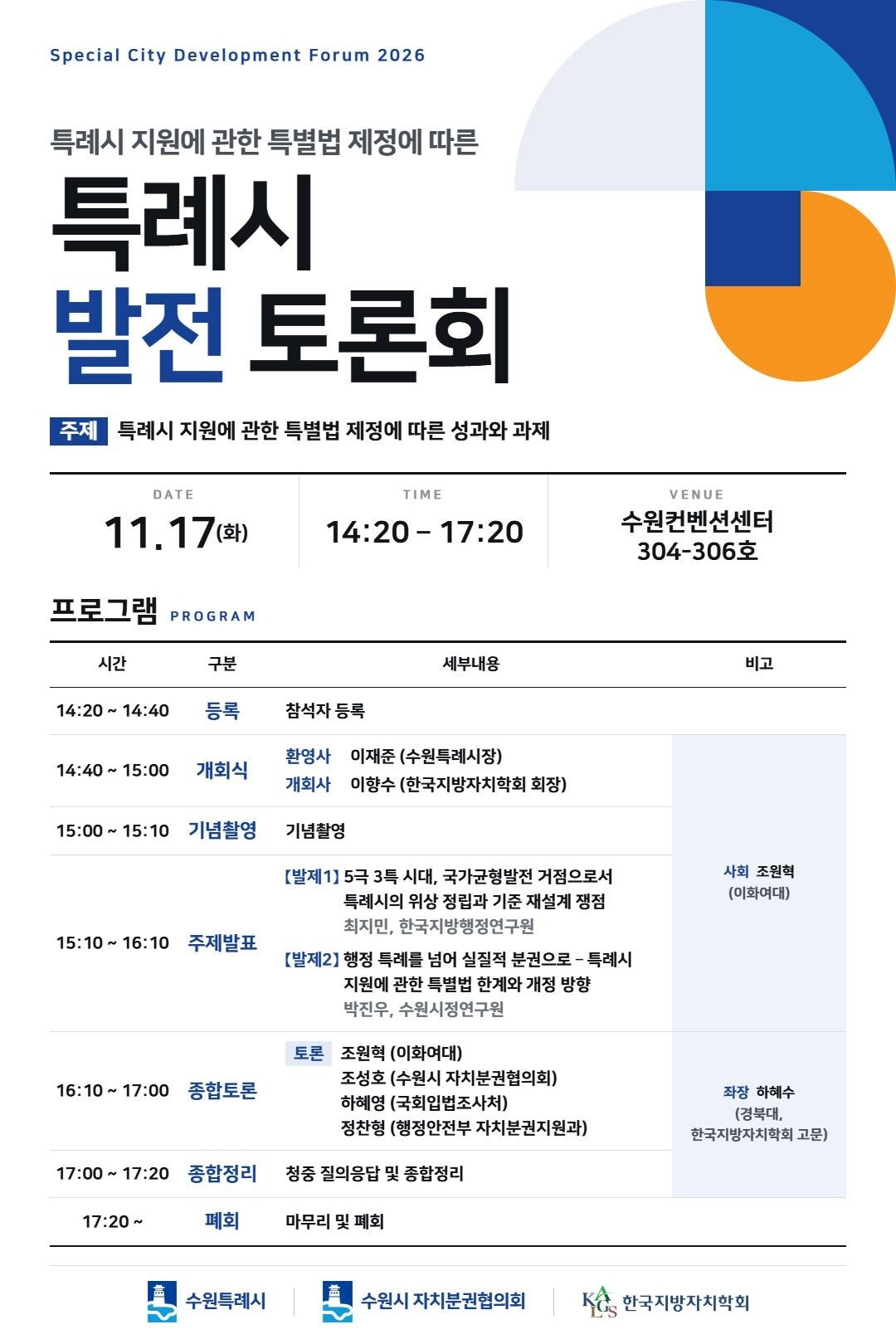
During the 5th to 7th elected terms, Suwon City resolved several long-standing goals. The realization of 'Suwon Special City' is a prime example. Suwon City raised the profile of 'Special City' in 2013 by conducting a 'research project on a local autonomy model for large cities with populations exceeding 1 million', and made tireless efforts toward its realization. The 7th elected term designated 'Suwon Special City Initiative' as the top priority task.
Finally, last December, the 'Comprehensive Local Autonomy Act Amendment' containing provisions to designate cities with populations of 1 million or more as 'Special Cities' passed the National Assembly plenary session. It was a historic 'event' in the history of South Korean local autonomy.
This year marked a significant achievement with the closure of the 'Suwon Station Sex Trade District' after more than 60 years. Suwon City worked steadily with police, civic organizations, and residents to rehabilitate the Suwon Station sex trade district, and on May 31, sex trade establishment owners voluntarily closed their businesses.
'Adjustment of irrational administrative boundaries' also achieved successive successes. The city adjusted administrative boundaries with Uiwang City in 2013, Yongin City in 2019, and Hwaseong City in 2020. In particular, the administrative boundary adjustment with Yongin City was accomplished after seven years of effort.
In January last year, the 'Shinbundang Line Gwanggyo~Homaesil Section Extension Project' passed preliminary feasibility assessment, bringing Suwon City one step closer to 'establishing a grid-pattern regional railway network'.
Once the 'Sinsuwon Line', a double-track commuter rail connecting Indukwon (Anyang), Suwon, and Dongtan, opens and the Shinbundang Line Gwanggyo~Homaesil section is extended, Suwon City will establish a 'grid-pattern railway network'.
The 'GTX (Seoul Metropolitan Area Express Railway) C Line Project', which passed preliminary feasibility assessment in 2018, and the 'Suwon-originated KTX Direct Connection Project', which constructs railroad tracks connecting Seojeongni Station and Jije Station to make Suwon Station a KTX departure point, are also underway. Once the Sinsuwon Line and the Shinbundang Line Gwanggyo~Homaesil extension section all open, Suwon City will have approximately 20 metro stations.
Over the past 11 years, the city has emerged as a 'safe city'. CCTV cameras, numbering 999 in 2011, increased to approximately 11,000 by 2021—an increase of more than tenfold. CCTV cameras installed throughout Suwon City serve as sentinels protecting citizens.
In March last year, the city established the nation's first 'Emergency Vehicle Priority Signal System'. The 'Emergency Vehicle Priority Signal System' tracks the location of 119 ambulances via GPS (Global Positioning System) at the Suwon City Integrated Safety Control Center when transporting emergency patients to hospitals, and automatically provides a green signal when the vehicle enters an intersection.
Suwon City, which has applied the emergency vehicle priority signal system to 119 ambulances, will expand the system to fire trucks and police cars starting in August.
Following the outbreak of COVID-19 in February last year, the city established the nation's first temporary residential facility at the basic local government level and has pioneered infectious disease response policies and projects such as operating the 'Suwon-style Overseas Entrant Management System', thereby establishing 'standards for local government infectious disease response'.
Through the 5th to 7th elected terms, Suwon City has also emerged as a 'humanities city'. Public libraries increased from nine in 2011 to 21, transforming the city into one where 'residents can reach a library within a 10-minute walk from home'. The city established a 'Humanities Team' in 2013—the first nationwide—and built infrastructure including Lifelong Learning Centers, SK Artrium, and Suwon Municipal I-Park Museum of Art.

Loading comments…