


37th Anniversary Special Series AI Great Transformation, Seeking the Path Vol. 1 - "AI Has Entered My Life," The Market Paradigm of Consumption Is Shifting
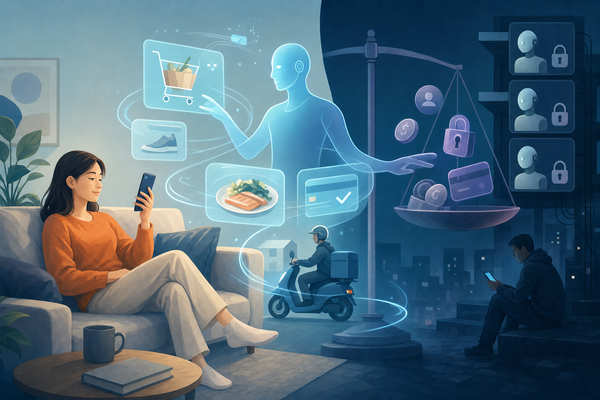
"What should I eat for dinner tonight?"
Instead of individually searching for restaurants on a smartphone to end the day, turning on an AI assistant application has become routine. AI recommends the optimal evening menu by synthesizing the user's diet, current location, and even health-related data. Then, it automatically applies the lowest-priced coupon through a delivery app and completes the payment all at once. The only action the consumer took was responding "Yes, let's go with that" to the AI's suggestion.
The paradigm of consumption is fundamentally changing. Beyond the era of simply searching and comparing information, the age of 'agentic commerce' is now in full swing, where AI learns consumer preferences and patterns to make optimal choices on behalf of consumers and handle payments.
The End of Search and the Invasion of 'Frictionless Commerce'
Global major economic institutions such as McKinsey forecast that AI-based agentic consumption and commerce markets will grow as a key axis that will fundamentally reshape future distribution landscapes. 'Frictionless commerce,' which technologically eliminates all the hassles consumers face from product exploration to payment, is restructuring the distribution ecosystem.
From the consumer's perspective, purchase fatigue has decreased and efficient consumption that does not miss out on the lowest price benefits has become possible. Meanwhile, the distribution industry faces an emergency. This is because 'being selected by AI algorithms' has emerged as the key variable determining survival, more so than brand awareness or conventional advertising. As AI assistants filter products based solely on price and efficiency, traditional marketing formulas are rapidly becoming ineffective.
The Backlash of Convenience...Global Major Countries vs. South Korea's 'AI Tax'
The problem is that advanced AI services come with substantial economic costs. As technology penetrates deeper into everyday life, the burden consumers must bear grows larger. Beyond simple free services, as customized and real-time features become essential, monthly recurring 'AI subscription fees (AI Tax)' are becoming a new fixed expenditure item in household budgets.
Comparing the digital subscription practices of global major countries reveals several distinctive characteristics in the subscription environment experienced by domestic consumers.
North American consumers typically pay directly for single big tech AI services such as ChatGPT Plus or Copilot Pro as needed. With relatively clear boundaries between productivity-focused business AI and entertainment subscriptions, a consumption pattern of flexibly canceling or re-subscribing to services as needed has taken root.
Meanwhile, regions such as the European Union are relatively conservative in adopting paid AI for households due to the impact of strong personal data protection regulations and AI-related legislation. With a higher proportion utilizing free open-source models or device default-installed features, the rate of increase in direct household subscription spending is relatively gradual.
In contrast, South Korea's domestic consumption market is characterized by a structure in which payments for original AI services from global big tech companies are tightly intertwined with shopping and membership-combined subscription products provided by portals, e-commerce platforms, and telecommunications companies. Exposure to exchange rate volatility when using overseas services, combined with domestic platforms' subscription economy ecosystems meshing together, has led to pointed observations that the experienced subscription fatigue is rising sharply.
'AI Divide' and the Wavering of Consumer Sovereignty
The burden of subscription fees extends beyond a simple increase in expenditure to social polarization known as the 'AI Divide' or digital class gap.
Those with payment capacity enjoy personal assistant services, automatic lowest-price searches, and customized care benefits through multiple AI subscriptions, saving both time and money. Conversely, vulnerable groups lacking economic means or unfamiliar with digital device operation face information inequality, excluded from these 'algorithm benefits' while paying relatively higher costs and consuming under unwanted conditions.
Additionally, concerns have been raised that as consumers passively purchase only products recommended by AI algorithms, consumer 'sovereignty'—the ability to compare and choose through one's own will—could be shaken by real-time dynamic pricing or platform algorithms.
"Taking Hold of 'Autonomous Consumption' Within Convenience"
It is an undeniable fact that AI provides consumers with groundbreaking convenience in their lives. However, in the shadow of convenience lie challenges of household expenditure pressure, digital gaps, and excessive dependence on algorithms.
Experts agree that during periods of technological transformation, proactive responses from both consumers and social safety nets are urgently needed.
Distribution and consumption experts suggest that "AI is a useful tool for increasing consumption efficiency, but the ultimate decision-maker and economic spender must ultimately be human" and emphasize that "it is urgent to review indiscriminate subscription burdens while simultaneously establishing institutional safeguards to protect consumers from unfair AI algorithm recommendations and price discrimination."
Within the sweet convenience extended by the AI assistant, there is a critical need for profound reflection on how to preserve 'consumer sovereignty' without falling into the passive role of an algorithm's object.



Loading comments…