


In-Depth Analysis "Brake Failure" vs. "Brake Light Malfunction"…Bundang Bus Runaway—Defect or Driver Error?
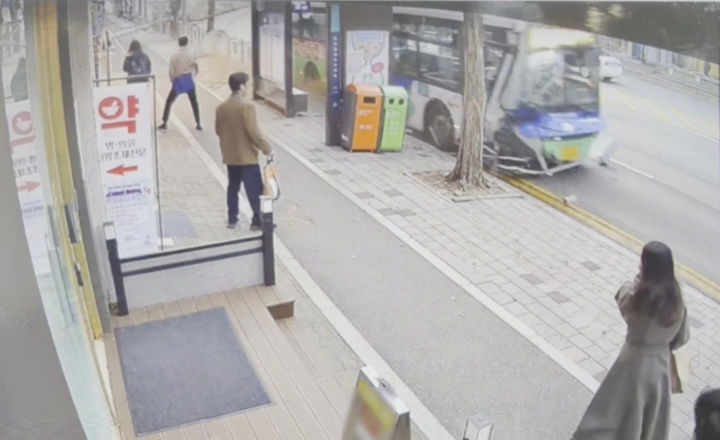
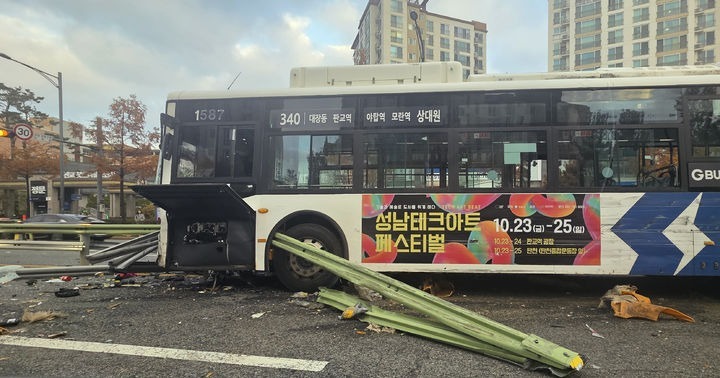
The cause of the chain-collision accident involving a city shuttle bus that occurred at 7:34 a.m. on the 11th in Bundang, Seongnam-si, Gyeonggi Province—which left 70 people moderately to seriously injured—is now at the center of a standoff between two competing theories: "mechanical and electronic malfunction of the electric bus (sudden acceleration)" and "driver pedal misapplication."
As police and the National Institute of Scientific Investigation (NISI) have launched a detailed analysis of the accident vehicle's event data recorder (EDR) and dashcam footage, experts are examining both hypotheses from multiple angles based on the physical characteristics evident at the time of the accident and precedent cases.
"Brakes Didn't Work"…Driver Claims Mechanical Defect
The shuttle bus driver, a man in his 60s identified as A, has consistently stated in police preliminary investigation that he pressed the brake pedal while operating the vehicle, but the braking system did not function normally. The fact that the bus continued at speed for over 150 meters even after the initial collision, sequentially striking 32 vehicles, suggests the possibility that the vehicle was in an uncontrollable state.
Electric Bus-Specific Electronic Control and Regenerative Braking Error Under Scrutiny
Particular attention is being drawn to the fact that the accident vehicle was an electric bus rather than an internal combustion engine vehicle. Electric vehicles employ regenerative braking systems that use motor deceleration in addition to hydraulic brakes, operating in combination with electronic control units (VCU).
If instantaneous communication disruption or error occurs in the vehicle control software such as the VCU, the possibility cannot be ruled out that regenerative braking could be deactivated while the electric motor simultaneously accelerates at high output. Additionally, the possibility of a defective electric brake booster causing the brake pedal to become stiff and physically resist depression is cited as a primary basis for the driver's statements.
Brake Light Non-Illumination Evidence…Points Toward Driver Pedal Error
Conversely, traffic safety experts and witness accounts place greater weight on driver negligence. Review of CCTV footage from the accident scene and dashcams from surrounding vehicles revealed that the bus's rear brake lights did not illuminate during its 150-meter surge. Most vehicles, including electric vehicles, are designed such that when the brake pedal is physically depressed, the brake lights activate via an independent electrical circuit regardless of whether the main control unit malfunctions.
According to analysis by the Korea Transportation Safety Authority, a significant number of sudden acceleration accident cases have been determined upon detailed investigation to result from pedal misapplication—drivers confusing the accelerator pedal with the brake. This is why the theory has emerged that, flustered after the initial collision, the driver may have believed he was pressing the brake while actually pressing the accelerator pedal hard, causing the vehicle to maintain or increase speed over the 150-meter section.
NISI's Precise EDR Forensic Analysis…5-Second Pedal Operation Examination
Police have requested the NISI to conduct forensic examination of the secured event data recorder, planning to intensively analyze the accelerator pedal displacement, brake pedal operation status, motor rotation speed, and vehicle velocity changes during the 5 seconds immediately preceding the accident.
Experts point out that given the ongoing debate over the reliability of EDR data in electric vehicles, an accurate determination of cause will require precise multilayered investigation including analysis of brake pedal switch operation records, compression marks on the pedal assembly, and examination of footwear impressions.



Loading comments…