


Seoul Declining Areas Expand from 3 to 5 Districts...Gyeonggi South Shows Strong Gains in 'Reverse Real Estate Trend'
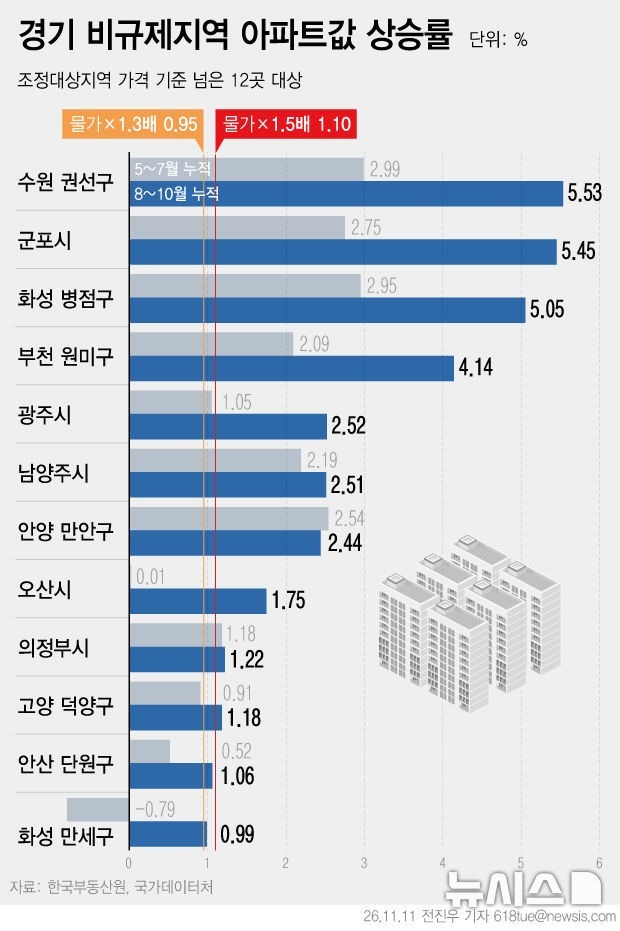
While Seoul apartment prices show declining areas expanding from the Gangnam Three Districts to Seongdong and Gangdong Districts, Gyeonggi Province is widening its gains centered on major areas like Yongin, Suwon, and Hwaseong, creating diverging flows in the capital region real estate market.
According to the Korea Real Estate Board's nationwide weekly apartment price trends for the second week of November (as of the 9th) announced on the 12th, Seoul apartment transaction prices rose 0.07% compared to the previous week. This marks 92 consecutive weeks of gains, but the number of districts with declining prices expanded from 3 last week to 5 this week.
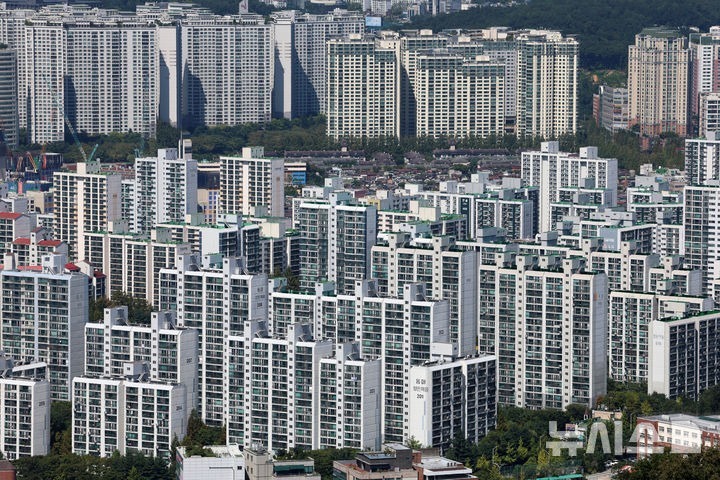
Gangnam-gu and Seocho-gu each fell 0.25% and 0.26% respectively, continuing 14 consecutive weeks of decline. Songpa-gu's decline widened more than twofold, from -0.17% last week to -0.35%.
Additionally, Seongdong-gu reversed from a 0.07% gain last week to a 0.02% decline this week, while Gangdong-gu also shifted from a 0.03% gain to a 0.01% decline. The price decline concentrated in the Gangnam Three Districts is spreading to some areas of the Han River belt.
Meanwhile, Seoul's outer areas maintained their uptrend. Seongbuk-gu recorded Seoul's highest rate at 0.39%, while Gangbuk-gu (0.32%), Seodaemun-gu (0.29%), and Dongdaemun-gu (0.28%) also showed strength.
Gyeonggi Province exhibited a different trend from Seoul.
Gyeonggi apartment prices expanded from 0.20% last week to 0.21% this week. This figure reaches three times Seoul's rate of 0.07% during the same period, with Gyeonggi's weekly gain rate topping Seoul for nine consecutive weeks.
By region, Yongin's Giheung-gu showed the most notable gain at 0.63%, while Suwon's Youngtong-gu expanded its rise from 0.43% last week to 0.60%, a 0.17 percentage point increase. Hwaseong's Dongtan-gu also rose 0.56%, continuing the strength of major residential areas in southern Gyeonggi.
The uptrend is also spreading to surrounding areas. Gunpo City and Anyang's Dongan-gu each rose 0.56% and 0.50% respectively, while Uiwang City and Hwaseong's Byeongjeom-gu both rose 0.47%. Bucheon's Wonmi-gu also recorded a high gain of 0.40%.
As high price increases continue centered on residential areas supporting the semiconductor industry, the simultaneous occurrence of price adjustments in Seoul's core areas and gains in major Gyeonggi regions is making regional price flow differences within the capital region increasingly distinct.
Meanwhile, nationwide apartment transaction prices rose 0.10%. The capital region rose 0.14%, non-capital regions rose 0.01%, and Incheon fell 0.01%.
Loading comments…