


Balloon Effect Overheats Prices in 12 Unregulated Areas of Gyeonggi Province…Prices Soar in Byeongjeom and Gunpo After Dongtan and Giheung Restrictions
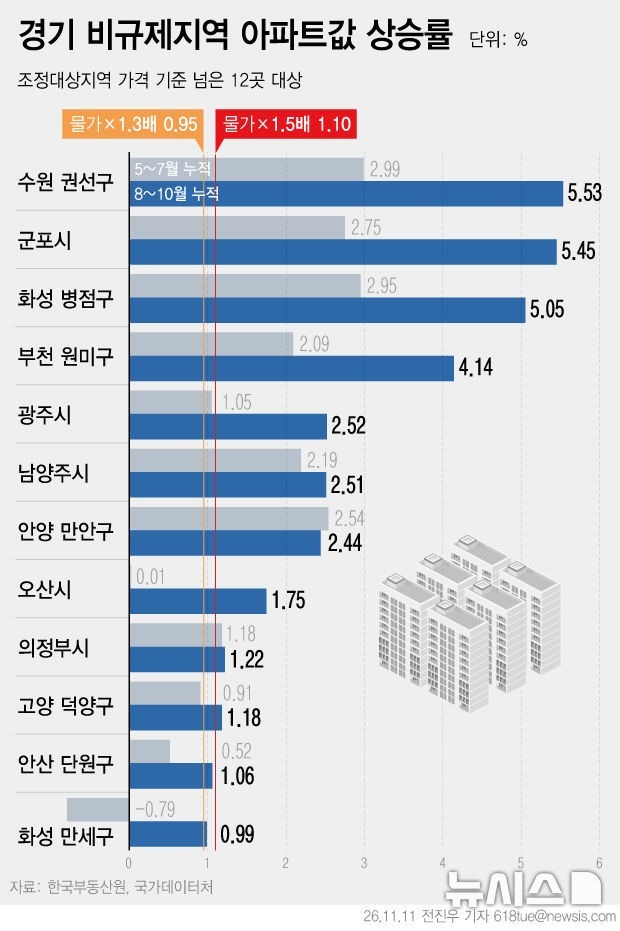
Despite government measures to designate major strategic areas in Gyeonggi Province including Dongtan and Giheung as regulated zones (adjustment target areas and speculative overheated zones), a "balloon effect" is intensifying, with buying activity concentrating in nearby unregulated areas, particularly in southern Gyeonggi Province.
According to analysis of the Korea Real Estate Board's weekly apartment price trends on the 12th and the Ministry of Land, Infrastructure and Transport's actual transaction price disclosure system, of the 29 cities and districts in unregulated areas of Gyeonggi Province, 12 of them recorded apartment transaction price increases exceeding 0.95% over the recent three months (August to October), the statutory threshold for designating adjustment target areas. Of these, 10 areas exceeded the 1.10% threshold for speculative overheated zone designations.
Leading the upward trend was Kwonseon-gu, Suwon, which rose 5.53% over the recent three months. This was followed by Gunpo City (5.45%), Byeongjeom-gu, Hwaseong (5.05%), and Wonmi-gu, Bucheon (4.14%). These areas had recorded appreciation rates in the 2% range during May to July before regulations were implemented, but their rate of increase more than doubled sharply immediately after adjacent areas were subjected to regulations.
The temperature of the transaction market is clearly different. In the third quarter, Gyeonggi Province's total apartment trading volume (based on reporting date) decreased 23.2% compared to the second quarter as wait-and-see sentiment intensified, but the trading volume in the 12 unregulated areas remained at 15,818 cases, increasing by 0.3% from the previous quarter. In particular, Osan City (34.7%) and Byeongjeom-gu (24.6%) recorded double-digit trading volume increases, absorbing actual transaction volume from outsiders.
This phenomenon is being driven by out-of-town buyers seeking to avoid loan regulations and real occupancy requirements. According to court registry information from the Ministry of Justice, in October alone, the number of transactions in which residents of Dongtan and Yeongdeung purchased collective buildings in Byeongjeom-gu was 132 cases, a 29.4% increase from the previous month (102 cases).
Real estate market experts suggest that "as the threshold for financing within regulated areas has risen due to restrictions such as the reduction in loan-to-value (LTV) ratios, actual demand and investment demand are shifting to nearby unregulated areas in line with available budgets," and forecast that "given the continued housing jeonse crisis in the Seoul metropolitan area, the concentration of purchases in adjacent unregulated areas is likely to continue for some time."
Loading comments…